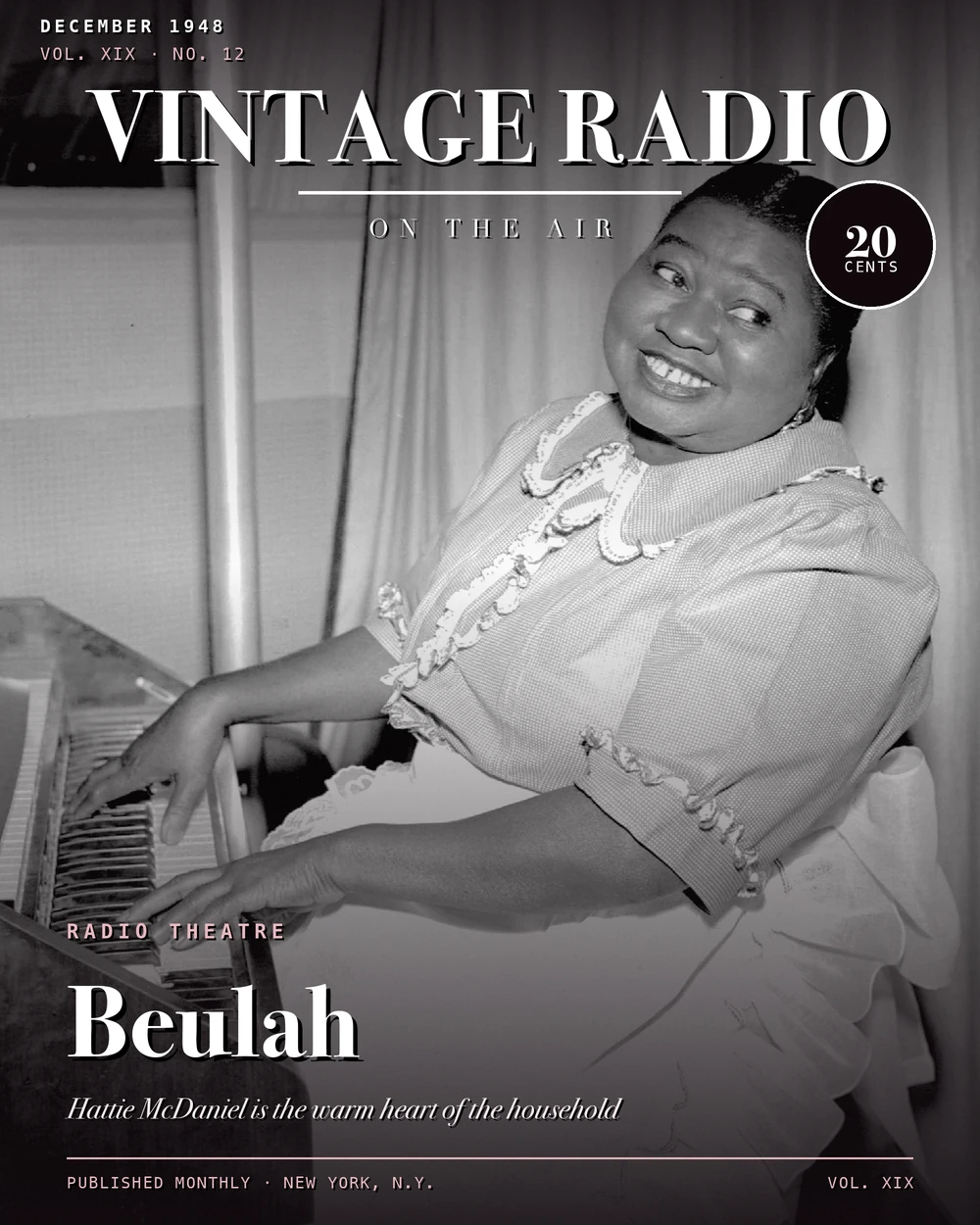
Beulah
How a Character Became a Show
Beulah Brown didn't begin as a star. She started in 1939 on a regional radio program called Hometown Incorporated, where Marlin Hurt first introduced the character and her voice — that warm, quick-witted, perpetually unflappable Negro maid who worked for whoever needed her most. After a stint on That's Life in 1943, Beulah joined Fibber McGee and Molly in March 1944 as a supporting player, and that's where everything changed. Her entrance — Hurt spinning away from the microphone with his back turned, then whirling around the moment McGee called out — brought down the studio audience every time. The catchphrase "Somebody bawl fo' Beulah?" became one of the most quoted lines in radio.
Don Quinn, the writer who created Fibber McGee and Molly, had first noticed Hurt years earlier on Maxwell House Show Boat, where Hurt was part of a singing trio called Tom, Dick, and Harry. Quinn filed him away and moved on. When wartime service stripped the McGee show of several key performers — including Bill Thompson, who was alone carrying four separate characters — Quinn went looking for Hurt again. He found him in the summer of 1943 doing dialects and playing saxophone on The Fred Brady Show, an NBC summer replacement, still performing his Beulah character. Quinn brought him in immediately.
Hurt was 39 when he joined the McGee cast, just beyond draft age, which suited Quinn fine. His Beulah voice grew from a real person: a Black woman named Mary who had cooked for the Hurt family when he was a child, and whose heavy accent and habit of scolding the children had stayed with him for decades. He experimented with that voice for years before putting it to professional use. When it finally aired on the McGee show, the response was immediate enough that Quinn spun it off into its own program: The Marlin Hurt and Beulah Show, which debuted on CBS on July 2, 1945, sponsored by Tums.
The Original Run and the Loss of Marlin Hurt
The first version of the show ran for 30 minutes and followed a "Turns" format — meaning the show was structured around variety-style segments rather than a single continuous story. Hurt played three roles himself: Beulah, her shiftless boyfriend Bill Jackson, and himself. Carol Stewart sang and also played a neighbor down the street. Ken Niles announced. Helen Mack produced. Phil Leslie, Quinn's longtime co-writer, handled the scripts, which gave the show the same quality of craft that the McGee program had established.
Two things were notably absent from the early spinoff. Beulah's two signature catchphrases — "Somebody bawl fo' Beulah?" and "Loooove dat man!" — couldn't be used at first because they legally belonged to Johnson's Wax, the sponsor of the McGee program where they'd been coined. The show had to build its identity without its own most famous material.
The first run ended on March 17, 1946, not because of ratings — the Hooper rating during the Hurt era had reached 11.1 in mid-1945 — but because Hurt died. He suffered a heart attack while playing golf on March 21, 1946, in Los Angeles. He was 40 or 41 years old. He had a star on the Hollywood Walk of Fame and is buried at Forest Lawn Memorial Park. Before radio, he had sung with the Vincent Lopez band and recorded with Frank Trumbauer's jazz group. The Beulah character he created and refined over years outlived him by nearly a decade.
Three More Runs, Three More Beulah
The show came back three times after Hurt's death, each time with a different actress or actor in the lead. The first attempt aired on ABC from February 24 to August 20, 1947, with Bob Corley — another white man — in the title role. That run lasted about six months.
The run that mattered came next. On November 24, 1947, CBS brought the show back as a 15-minute daily strip, airing weekdays at 7, sponsored by Procter & Gamble for Dreft. And Hattie McDaniel took over the role.
McDaniel was not an unknown quantity. She had won the Academy Award for Best Supporting Actress for her role as Mammy in Gone with the Wind (1939), becoming the first African American to win an Oscar. She had also been the first Black woman to sing on radio in the United States, having begun performing on radio in Denver in the mid-1920s. The NAACP was initially pleased by her casting — she was the first Black woman to star in a network radio program. And the audience noticed: McDaniel earned $1,000 a week for the first season and doubled the ratings the original series had drawn.
McDaniel played Beulah through four full seasons. The supporting cast around her — Hugh Studebaker as Harry Henderson, Mary Jane Croft as Alice Henderson, Henry Blair as their 10-year-old son Donnie, Ruby Dandridge as Oriole the next-door housekeeper, and Ernie "Bubbles" Whitman as Beulah's elusive boyfriend Bill — gave the show a stable, practiced ensemble. Tom McKnight directed. Marvin Miller announced. The writing staff at various points included Sol Saks, Herb Finn, Bill Freedman, Sherwood Schwartz, Arthur Julian, Hal Kanter, and Howard Leeds — a roster that would go on to create Bewitched, Gilligan's Island, and The Brady Bunch, among other things. Hal Kanter later confirmed that Schwartz "proved to be a writer with a unique approach" during their time on the show.
McDaniel became ill in early 1952 and could no longer carry the role. Amanda Randolph was the logical choice to succeed her, but a clause in Amanda's Amos 'n' Andy contract blocked her from taking it immediately. Her sister Lillian Randolph stepped in and finished the 1951–52 season. By 1953, Amanda had negotiated a new contract with Amos 'n' Andy that removed the restriction, and she assumed the role for the show's fourth and final run — back on CBS from September 28, 1953 to May 28, 1954, now airing at 7:15 and sponsored by General Foods, General Motors, and Murine. Steve Hatos produced and directed. Johnny Jacobs announced. Most of the third-run cast returned with Amanda Randolph, with Sammy Ogg replacing Henry Blair as Donnie.
What the Character Was, and What She Became
Marlin Hurt had a specific vision for Beulah that he talked about in some detail. As he saw her, Beulah was in her 30s, weighed about 140 pounds, had good teeth, wore her hair in bangs and a pageboy bob, favored short skirts and extremely high heels, and was decidedly not lazy — her own catchphrase on that subject being "All work and no play makes jack." She was conceived as a working woman with opinions, not a comic prop.
But through the Hurt years, the character remained, in essence, a novelty. The humor depended at least partly on the concept of a white man voicing a Black woman, and the audience knew it. It wasn't until Hattie McDaniel took the role that Beulah moved past that frame and developed into something with genuine staying power. The character's situation — the cook and maid whose practical intelligence consistently bailed out the household she worked for — became the show's actual engine. Beulah solved the problems. The Hendersons, for all their middle-class comfort, needed her.
The NAACP eventually landed on a different view. At its June 1951 annual convention, it condemned both Beulah and Amos 'n' Andy for depicting Black characters in a derogatory manner. The organization chose to pursue a consumer boycott against the Amos 'n' Andy sponsor rather than Procter & Gamble, so Beulah continued without direct economic pressure. But the criticism was on the record, and it attached to the show's legacy regardless of what the ratings said.
The Television Years
In 1950, Roland Reed Productions adapted the show for television, and the result made history in ways the radio version never had. The television Beulah premiered on October 3, 1950, on ABC, and became the first nationally broadcast weekly television series starring an African American in a leading role. It was also ABC's first hit situation comedy, and the first hit TV sitcom to air without a laugh track.
Ethel Waters starred in the first season, filming at a studio in the Bronx while simultaneously appearing on Broadway in The Member of the Wedding. When production moved to Hollywood for the second season, Waters chose not to relocate — not, as sometimes reported, because she objected to the show's content — and left the series. Hattie McDaniel stepped in and filmed six episodes during the summer of 1951, but fell ill before they could air; those episodes were shelved and eventually broadcast in July and August of 1952. Louise Beavers then carried the third season.
The television critics were not kind from the start. The New York Times review of the premiere episode criticized "calculated mistakes in grammar most commonly identified with minstrel shows" and called the program "not very modern." Syndicated critic John Crosby specifically singled out Ethel Waters, and some critics in the Black press viewed her participation as a step backward from her standing as a celebrated vocalist and Broadway actress. Percy "Bud" Harris, who originated the role of Bill Jackson in the TV series, walked out partway through the first season accusing the producers of forcing him to play an "Uncle Tom" character. He was replaced by Dooley Wilson, the pianist from Casablanca.
The series ran through September 22, 1953, and produced 87 episodes, all of which entered syndication in the latter half of the 1950s through a company called Flamingo Films. When Flamingo went out of business in 1963, the show effectively disappeared. The television series ended not because of low ratings — Beulah was still drawing well in September 1953 — but because Louise Beavers chose to leave. After the cancellation, Black characters largely vanished from scripted television. The next program to star a Black woman in a title role was Julia in 1968, with Diahann Carroll.
Hattie McDaniel died of breast cancer on October 26, 1952, in Woodland Hills, California. Her Oscar, which she had bequeathed to Howard University, subsequently disappeared — reportedly during the unrest following the assassination of Martin Luther King Jr. — and has never been recovered or replaced by the Academy. In 2006, she became the first Black Oscar winner honored with a U.S. postage stamp. The 2001 documentary Beyond Tara: The Extraordinary Life of Hattie McDaniel, hosted by Whoopi Goldberg and directed by Madison D. Lacy, examined her life and her central place in the Beulah story. Elizabeth Kolbert's 1993 New York Times article "From Beulah to Oprah: The Evolution of Black Images on TV" traced the show's longer cultural shadow, a line that ran from Hurt's 1939 debut performance to the television landscape that followed in Beulah's wake.